I remember talking to a trader once who joked, “Crypto only works until you need to buy rice.”
That line stuck with me.
Because now, in a small island nation in the Pacific, crypto is helping people buy rice. And fuel. And pay bills.
The Marshall Islands has rolled out a nationwide universal basic income (UBI) program — and yes, crypto is one of the ways people can get paid.
Every citizen now qualifies for about $200 every three months, roughly $800 a year. It’s not meant to make anyone rich. The goal is simpler: help cover rising living costs and slow the steady flow of people leaving the country.
The first payments went out in late November. People could choose how they wanted the money. Old-school bank deposit. Paper check. Or a government-backed digital wallet that sends funds over the blockchain.
No hype. Just options.
HISTORIC NEWS 🇲🇭
— Crossmint (@crossmint) December 16, 2025
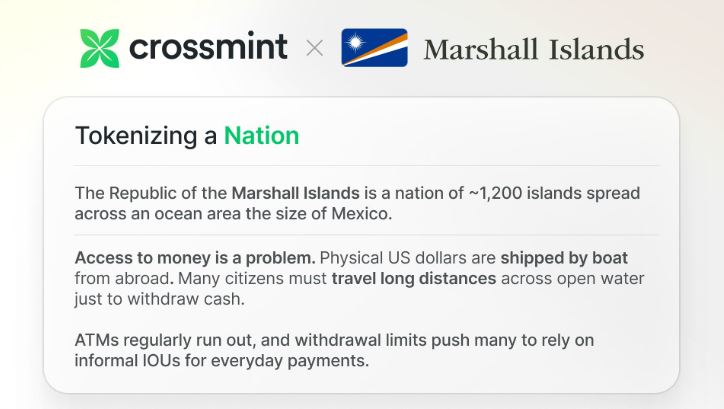
We’re helping tokenize a nation.
The Marshall Islands is launching blockchain-based UBI, giving citizens dollar-denominated tokens they can receive, store, and send peer-to-peer from their phones.
Powered by Crossmint Wallets pic.twitter.com/lvAWjTI6SW
This isn’t about replacing work
Finance Minister David Paul was clear about that.
This UBI isn’t meant to replace jobs or turn people into full-time recipients. It’s a safety net, he said. A way to make sure no one falls through the cracks. A small morale boost. Something steady people can count on.
The Marshall Islands has about 42,000 residents, scattered across dozens of remote atolls between Hawaii and Australia. Delivering basic services there isn’t easy. Getting money to people can mean boats, flights, and long delays.
That’s where crypto comes in.
Officials say the blockchain option helps reach people who live far from banks or government offices. No long travel. No waiting weeks for checks to arrive.
Where the money comes from
This program isn’t being funded out of thin air.
The payments come from a trust fund tied to a long-standing agreement with the United States, partly created to compensate the Marshall Islands for decades of U.S. nuclear testing in the region.
That fund holds over $1.3 billion today. The U.S. has also committed another $500 million through 2027.
So this isn’t a short-term experiment. It’s built to last.
A global first, quietly happening
Dr. Huy Pham from RMIT University called it what it is: a first of its kind.
This is the world’s first national rollout of a UBI program using blockchain as a payment option. Countries talk about this stuff all the time. The Marshall Islands just… did it.
The crypto used is a U.S. dollar-pegged stablecoin, not a volatile token. That choice matters. Prices stay stable. Transfers are fast. And every payment can be tracked across hundreds of islands.
But adoption is slow — for now
Here’s the reality check.
Most people are still choosing traditional options. About 60% of the first payments went straight to bank accounts. Most of the rest were paper checks.
Only around a dozen people have opted for the digital wallet so far.
That’s not a failure. It’s normal. Trust takes time. New tech always moves slower in the real world than on Twitter.
Zooming out: UBI and crypto aren’t just theory anymore
The Marshall Islands isn’t alone in thinking this way.
Sam Altman’s World project — originally called Worldcoin — is also chasing the idea of a global UBI system. Its approach is different. It uses biometric scans to prove someone is a real human, not a bot. One person. One ID.
Verified users receive allocations of the WLD token, which some see as a form of digital UBI inside the network. World now runs its own Ethereum layer-2 chain and claims 15 million verified users worldwide.
Big idea. Big debate.
But the Marshall Islands shows something important.
Crypto doesn’t have to be theoretical. It doesn’t have to be speculative. Sometimes it’s just a tool. A way to get money to people who need it — on time, every time.
No moon talk. No slogans.
Just money, moving where it’s needed.