Hong Kong didn’t always feel like a crypto-friendly city. For a while, it felt cautious. Careful. Almost hesitant. That mood has clearly changed.
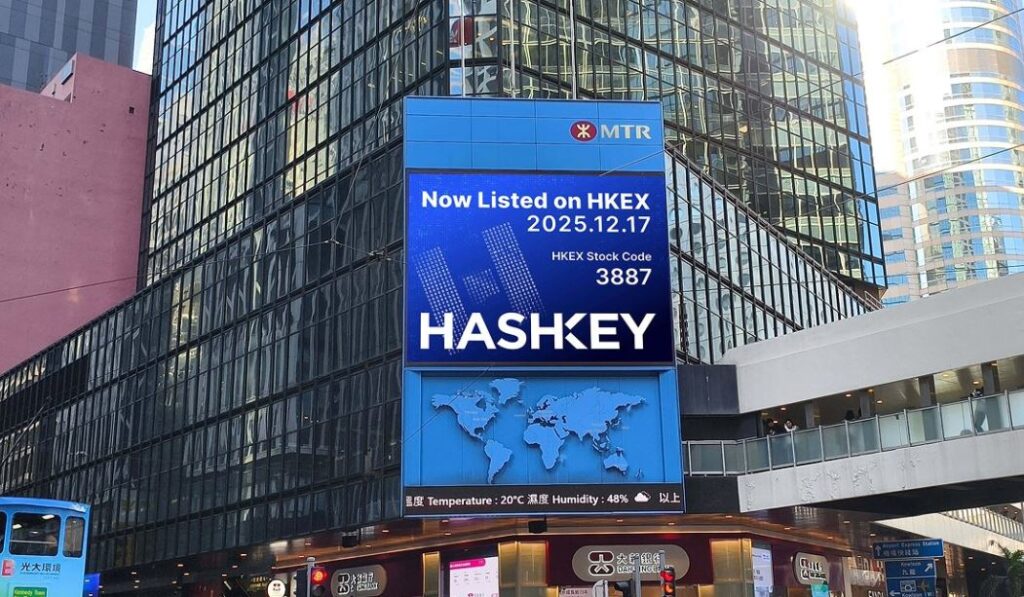
Today, HashKey Group’s shares began trading in Hong Kong, just days after its IPO. And this debut says a lot more than “another crypto company goes public.” It shows how serious Hong Kong has become about digital assets.
HashKey launched back in 2018. Fast forward to now, and it runs Hong Kong’s largest licensed crypto exchange. According to its IPO prospectus, the exchange processed a staggering 1.7 trillion Hong Kong dollars — about $218 billion — in trading volume by September 30, 2025. That’s not retail hype. That’s real institutional-scale activity.
The business isn’t limited to trading either. HashKey operates across staking, tokenization, and asset management. Still, growth hasn’t been perfectly smooth. The company reported 283 million Hong Kong dollars, or around $36 million, in revenue for the first half of 2025. That’s a 26% drop year over year. Expansion is happening, but margins are clearly under pressure.
The IPO itself raised 1.6 billion Hong Kong dollars, roughly $206 million, based on reports from Bloomberg and Reuters. In a market where crypto stocks have struggled lately, that’s a meaningful vote of confidence.
Hong Kong’s crypto push didn’t come out of nowhere. Since 2022, the city has been steadily rolling out rules instead of roadblocks. Alongside Singapore, it became one of the first Asian hubs to introduce a formal licensing regime for crypto exchanges. Right now, 11 exchanges are licensed. HashKey is one of them.
“Hong Kong has one of the clearest and most proactive regulatory frameworks for digital assets in Asia,” says Anna Liu, CEO of HashKey Tokenization. She describes the city as a gateway — connecting East and West, and traditional finance with blockchain-native systems. It sounds like a pitch, but the infrastructure is starting to back it up.
Earlier this year, Hong Kong introduced a licensing framework for stablecoins. That move caught attention quickly, especially given the long-standing stability of the Hong Kong dollar. Regulators are also considering allowing local exchanges to link directly with their global platforms. If approved, Hong Kong-based users could trade seamlessly with international markets.
“These measures give institutions certainty,” Liu explains. In her view, Hong Kong is pushing crypto away from speculation and toward compliance, predictability, and long-term capital. That’s usually when serious money shows up.
What makes Hong Kong’s stance even more interesting is the contrast with mainland China, where crypto trading remains banned. Thanks to its separate governance system, Hong Kong can chart its own path. Some in the industry see it as a live experiment — a signal of how Beijing might approach digital assets down the road.
Liu avoided guessing China’s next move. But she made one thing clear: clarity matters. Knowing the boundaries helps companies build without fear of sudden policy shifts.
HashKey joins a growing list of crypto firms that have gone public this year. Circle, Bullish, and Gemini all listed shares too. Circle and Bullish raised over $1 billion each, helped by renewed investor optimism following the Trump administration’s crypto-friendly policies, including the GENIUS Act.
That optimism hasn’t lasted across the board. Circle’s stock is down about 70% from its June peak. Bullish has fallen more than 30%. Gemini is off over 60% since its debut.
Crypto prices have followed a similar path. Bitcoin is down roughly 30% from October highs. Ether has dropped around 40%. Add geopolitical tension, AI bubble fears, and broader market stress, and risk appetite has clearly cooled.
Even so, HashKey’s debut comes at a strong moment for Hong Kong’s stock exchange. IPO activity is surging. Companies are coming back. According to KPMG, Hong Kong now ranks first globally for IPO fundraising for the first time since 2019, ahead of both major U.S. exchanges.
That context matters.
HashKey’s first day of trading isn’t just about one company or one stock chart. It’s about Hong Kong signaling, once again, that crypto has a regulated, structured, and very real future in the city — volatility included.