
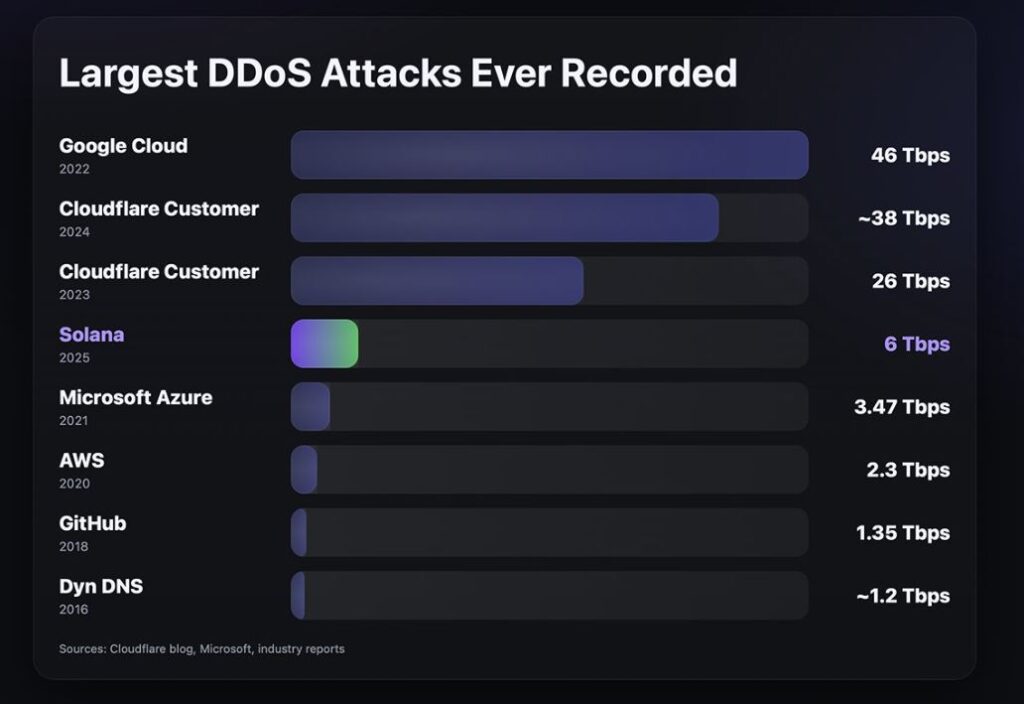
You know a network is serious when attackers throw everything they’ve got at it, and Solana just got a full-on stress test. This week, co-founder Anatoly Yakovenko revealed that the blockchain was hit by a DDoS attack peaking near six terabits per second (Tbps).
That’s right, six trillion bits of traffic and basically an “industrial-scale” digital hurricane.
Yakovenko even called it “bullish”, which might sound crazy at first. But here’s the thing: if someone’s willing to spend what the network makes in revenue just to slow it down, it’s actually a sign that Solana’s ecosystem is worth attacking. And despite the massive load, the network held up without showing major signs of stress.
Other voices in the ecosystem, like David Rhodus from Solana-based DePIN project Pipe Network, echoed the sentiment. He described the attack as one of the largest in internet history, handling billions of packets per second. Normally, this kind of traffic would tank performance; delays, missed blocks, confirmation issues, but Solana barely flinched.
The ongoing DDoS attack on @solana is one of the largest in internet history.
— Pipe Network (@pipenetwork) December 16, 2025
6 Tbps volumetric attack translates to billions of packets per second.
Under that kind of load, you'd normally expect rising latency, missed slots, or confirmation delays.
Instead, data shows:
•… https://t.co/QxpzOBOSh2 pic.twitter.com/P601xSgHiE
Solana’s Rough History
Let’s be honest: Solana isn’t new to downtime. Back in December 2020, a block propagation bug stopped the network cold. September 2021 saw a 17-hour outage thanks to Grape Protocol’s onchain launch, which flooded the system much like a DDoS.
2022 wasn’t any easier: three separate outages ranged from transaction spam by bots to consensus bugs. 2023 and 2024 were quieter but still had incidents, a 19-hour downtime in 2023 and a five-hour hiccup in 2024 due to software bugs.
Compare that to Bitcoin. BTC has basically been a Swiss watch of uptime: over 99.99% operational since 2009, with only two major incidents- one in 2010 (value-overflow bug) and one in 2013 (network split). Bitcoin rarely stutters, which makes Solana’s occasional outages stand out… but also highlight the network’s growth pains.
Why This DDoS Could Be a Good Sign
Yakovenko calling the attack bullish isn’t hype, it’s perspective. Big attacks often happen because networks are gaining traction and attention. Solana’s throughput and ecosystem are growing fast, making it a target, and surviving a six-Tbps storm sends a message: the network is resilient, even under pressure.
For traders, developers, and ecosystem builders, this is actually encouraging news. Solana has historically struggled with downtime, but each incident leads to fixes, upgrades, and stronger infrastructure. If you’re looking for projects with real-world stress tests baked in, this is one of the few blockchains that’s getting battle-tested in real time.
In short: Solana got attacked hard. And it didn’t break. That’s a story worth watching in the crypto world.